How Do You Get an Accurate PVC Roofing Quotation?
- What Makes a PVC Roofing Quote Accurate?
- What Project Information Should You Send First?
- Which Product Specification Must the Quote Identify?
- How Should Installed Coverage and Quantities Be Checked?
- Which Roof-System Items Belong in the Quote?
- What Technical Evidence Is Needed Before Pricing Is Firm?
- How Do Packaging, Shipping, and Commercial Terms Change the Total?
- How Do You Compare Two PVC Roofing Quotes Fairly?
- When Should You Request a Revised Quotation?
- A Practical RFQ and Quote-Review Checklist
- FAQ
- Can I get a PVC roofing price from roof area alone?
- Is the price per square meter based on nominal sheet area or installed coverage?
- Can I reuse an archived packing or container quantity?
- Does an R1050 quote identify one material and one roof profile?
- Are ridge pieces, fasteners, and delivery automatically included?
- Are Pingyun samples free, and who pays to ship them?
- Does a 20-year policy apply to every PVC roof sheet?
- When should I ask for a new quote instead of relying on the first one?
- Conclusion
- References
To get an accurate PVC roofing quotation, send the supplier a dated roof plan, project and destination requirements, and a defined delivery scope. Ask the supplier to identify the exact current product, its installed cover and lap details, sheet lengths, compatible accessories, supporting documents, packing, delivery terms, and exclusions. Compare offers for the same roof, complete system, and delivery point. A price for an unnamed sheet or an area estimated from an old catalogue is a budget indication, not a dependable purchase-order quotation.
Accuracy here means that the price can be traced to a specified product and a stated quantity under agreed conditions; it does not mean that no project condition will ever change. Importers, distributors, contractors, and purchasing teams need different outputs from the same process. Pingyun’s website presents several roofing categories and a sequence for discussing product details, lead time, payment, and shipping [1][2]. Its archived catalogue shows why a familiar model code cannot replace the current specification [3]. This guide turns those observations into a practical request-for-quotation process without treating old promotional data as present-day engineering or commercial commitments.

What Makes a PVC Roofing Quote Accurate?
The number at the bottom of an offer is only as useful as the assumptions above it. Two suppliers can quote different totals while both believe they are pricing the requested roof: one assumes nominal sheet width, another installed cover; one includes ridges, another excludes them; one quotes goods at its premises, another includes freight to a named destination. An accurate quote identifies these differences so a buyer can verify and, if necessary, revise them before an order is placed.
Distinguish a budget indication from an order-ready price
At concept stage, a buyer might know only an approximate roof area and preferred appearance. A supplier can give a conditional budget range or an indicative unit price, provided it labels the assumed material, thickness, quantity, delivery basis, and missing information. It would be misleading to call that an installation-ready total. The final figure can change when the design establishes effective cover, permitted lengths, slope details, penetrations, and accessories. A useful budget reply states precisely what must be confirmed to firm it up.
A technically reviewable quotation takes a further step. It attaches a named profile and current section drawing, states the proposed installation method and scope, and identifies which tests or reports the design team must consider. It may still be conditional on a designer’s approval or on the final packing plan. An order-ready quotation carries the agreed product and document revisions, itemized quantities, commercial delivery terms, acceptance conditions, and a written procedure for changes. “Order-ready” does not itself mean the roof has been independently approved; the project’s responsible professional still reviews suitability.
Ask the supplier to put a status and date on each offer. If a revision follows an approval, state what changed from the previous version. Importers may need a commercial offer before technical review finishes, but should not release manufacture against an older, ambiguous version. Contractors should avoid making a construction sequence depend on a conditional figure that excludes the ridge or daylighting transition. A distributor replenishing standard stock needs an equally clear product code and packaging description, even if no particular roof plan is attached.
Apply one roof, one scope, and one delivery basis
Give every bidder the same project pack and ask each to return a list of deviations. Specify whether the supplier prices only field sheets or a full system including compatible trim, closures and fasteners. Define the delivery point rather than writing only “delivered” or “shipping included.” The price comparison must also use the same currency, unit of sale, quote date, and treatment of taxes and other charges. If information is unavailable, mark it open; do not silently assume that every bidder included it.
The practical test is whether a reader unfamiliar with the correspondence can reproduce what is being bought. Can the estimator trace sheet counts to a current installed-cover figure? Can the installer identify the approved accessories? Can purchasing tell which party pays a stated freight charge? If not, the offer may still help with early budgeting, but the buyer should ask for a revision before choosing the apparent lowest bidder. A well-qualified quotation is more useful than a precise-looking total built on unstated guesses.
What Project Information Should You Send First?
Suppliers can propose alternatives, but they cannot infer the buyer’s roof geometry, approval regime, or unloading conditions from the phrase “PVC roofing.” Start with a concise, dated request pack. If it is a stock purchase, replace the roof takeoff with a stock schedule while still defining product construction, quantities, packaging, destination, and required support materials. A fair comparison requires the same brief to reach each candidate, with any later clarification distributed to all bidders who remain under consideration.
Provide drawings and site conditions
Send a roof plan, elevations, sections and dimensions that show every roof plane, ridge, hip, valley, eave, verge, wall abutment, penetration, and daylighting area. Identify the proposed slope, support construction, any known loading or exposure requirements supplied by the project designer, and whether the work is new construction or a replacement. If the structure has not been surveyed, say which assumptions are provisional. The supplier can then identify what its current installation instructions cover and where it needs more information.
Do not treat gross plan area as installed roof area without reviewing slopes and irregular geometry. A long sheet may be appropriate on one plane and impractical on another because of transport, lifting, pattern alignment or site access. Send photographs of existing conditions when useful, but accompany them with dimensions and the designer’s information; a photo cannot establish a profile’s edge shape or support capacity. If a contractor has not yet measured an existing roof, request a budget price subject to a survey rather than a firm match to a similar-looking old tile.
Identify who makes final technical decisions. The manufacturer supplies product drawings and instructions; the responsible designer evaluates the building, local requirements and project assembly. The contractor plans installation. Putting those roles in the RFQ prevents the supplier’s budget estimate from being mistaken for structural or code approval. If a wall junction is to be designed by another trade, show it on the drawing and say whether its materials are included in the roofing quotation.
State destination, quantities, and timing
Give the destination country and the precise intended delivery point. For imports, say whether the request is for ex-works goods, a named port or another specified place only when the buyer understands the associated cost and risk allocation. Identify who handles unloading and whether there are site access restrictions. State a realistic required delivery window, not just “urgent,” and tell the supplier whether colors, lengths, samples, technical submissions, or payment approvals remain outstanding.
For a distributor, specify the proposed stock mix by profile, color, construction and length rather than a single aggregate area. Ask which accessories and sample pieces should be included, how cartons or bundles will be identified, and whether future replenishment must match an existing stock version. For a contractor, provide a preliminary length schedule or ask the supplier to prepare one from the drawings, clearly identifying who takes responsibility for its accuracy. Different order mixes can require different packing and production arrangements; an archived container quantity is not a current shipment plan [3].
Pingyun’s Custom page publicly describes a process of recommending a model, confirming length, width, thickness and color, then discussing lead time, payment and shipping [2]. That sequence is a useful reminder of the data the buyer and supplier must exchange. It is not a promise that a particular order has a specified lead time, minimum quantity, freight rate or payment term. Write those details into the actual quotation once the proposed product and destination are known.
Mark missing inputs instead of hiding them
Use a short assumptions register alongside the RFQ: each open item, who will decide it, its expected date, and whether it could affect product identity, quantity or price. Typical examples are an unconfirmed ridge detail, a possible rooflight, color approval, local test submission or unloading method. Ask each supplier to price a clearly identified base case and, where appropriate, a separately priced option. This makes an estimate useful without pretending an unresolved design has disappeared.
Do not allow “as required” to stand in for a measurable quantity or an identified responsibility. If the installer has not selected a fastener, the supplier should state which fastener its detail assumes and whether it is included. If the roof plan may change, establish the revision used for pricing. The buyer can then compare offers against that revision and update them when new drawings arrive. A documented provisional allowance is better than an unmentioned omission, but it must be labeled as provisional.
Which Product Specification Must the Quote Identify?
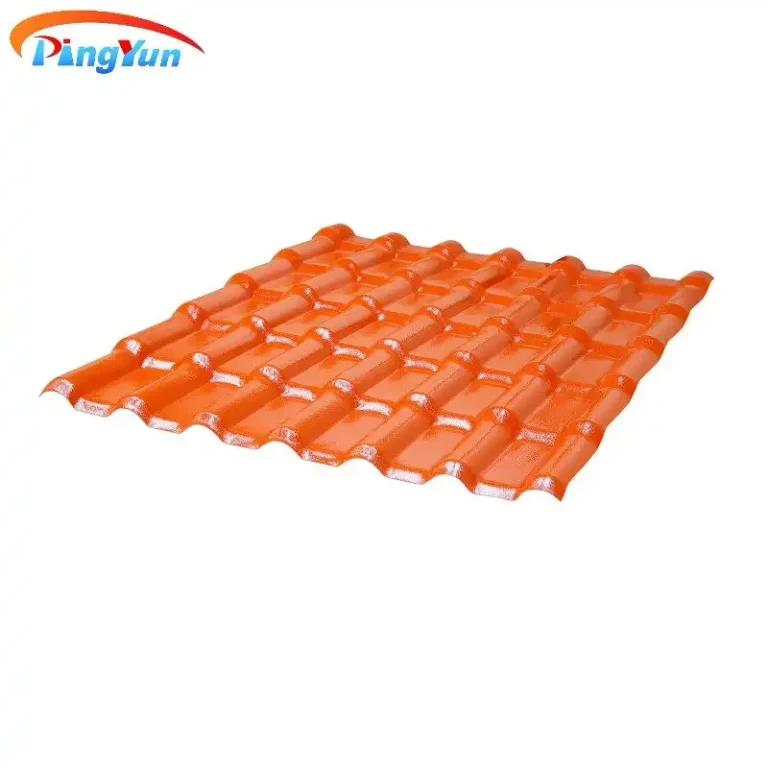
The quoted item has to be more specific than “PVC roof tile,” “Spanish,” or “Roma.” Pingyun’s current navigation lists Spanish and Roma under its PVC Roof Tile category and lists other plastic roofing sheets separately [1]. A category helps the buyer find candidates, not identify the exact construction being supplied. Request the current SKU, material or surface description, profile drawing, offered thickness and color, available lengths, unit of sale, and accessory family. Put the drawing revision and product code on the same quotation line so the documents cannot be separated later.
Identify the current SKU, profile, and material
Ask whether the product is an opaque tile-like sheet, another profiled PVC or UPVC sheet, or a light-transmitting sheet. The supplied unit may be a long profile rather than a small piece corresponding to each decorative tile on its surface. Obtain the transverse section showing both side edges and a longitudinal drawing if the visible pattern repeats along the slope. Confirm that the sample, product declaration and offer refer to the same current version. A photograph may demonstrate appearance but cannot specify an installed joint.
Pingyun’s older PINGYUN New catalogue 201804.pdf separately listed Spanish style R1050 and Roma style R1080 as ASA-PVC entries and a translucent R1050 as PVC [3]. The significance for an RFQ is not that the old dimensions should be copied into a new order. It is that “R1050” by itself does not establish whether the buyer is pricing an opaque ASA-PVC roof tile or a translucent product. The current website’s Roma category also includes a product title containing “Roma R1050” [4]. Ask the seller to identify the actual section instead of assuming a universal one-to-one code-to-style mapping.
For every alternative, use a separate quote line with its own material, profile and applicable documentation. If two visually similar options have different constructions or cover widths, do not merge them to create a single average price per square meter. A distributor may want multiple stock variants; a contractor may prefer one version for the project. Both can obtain useful prices, but each version needs a name and technical definition that survive from quotation through packing and receipt.
Separate ASA-PVC, opaque, and translucent variants
The ASA distinction is relevant to material identity and Pingyun’s directly confirmed commercial policy: ASA products carry a 20-year warranty and other products a 10-year warranty [6]. Before applying the ASA category to a quotation, ask for the current SKU-specific material statement and written warranty. Do not infer that every product under a broad PVC heading qualifies. Nor should a historical catalogue’s longer promotional wording replace the policy and the current order-specific terms [3][6]. Warranty duration is not a verified service life for the installed roof.
If a daylighting area is requested, identify the exact translucent product as a separate line item. Request its material, section, installation instructions and a documented transition to the opaque roof. The historical translucent R1050 and opaque ASA-PVC R1050 used different material descriptions [3]; a shared string does not prove they can be overlapped directly or that their fastening and movement details match. When a direct joint lacks support, a project designer may need a framed opening or another approved assembly. The supplier should price that work only after its responsibilities and detail are defined.
Clarify whether custom colors or surface options are offered for the exact product rather than extrapolating from a general customization page. If a chosen finish requires a different accessory color, both should appear in the schedule. For sampling, Pingyun’s user-confirmed policy is that samples are free and customers bear freight [6]. The particular model, size, availability and dispatch arrangement still need confirmation. Sample freight and bulk-goods transport belong in different commercial lines, not in a single vague “free sample and shipping” promise.
Keep revision-controlled documents with the offer
A reliable offer identifies the current product drawing, installation manual, applicable material description, accessory schedule and quotation revision. Ask which document governs if a public product page, an old PDF and the signed offer differ. When the supplier changes an edge shape, surface construction or trim piece, the quote and technical submission should be revised together. This matters when buying against a designer’s approval: a supplier cannot silently substitute a tile with the same marketing name if its joint or material differs.
Record the sample’s label and date in the document register. An approved color swatch may establish appearance but not installed geometry; a profile section can establish a proposed shape but not a tested load capacity; a product report has its own scope. Keeping these distinctions visible prevents a pile of apparently persuasive documents from being mistaken for evidence about the same current item. A buyer should ask for a written reconciliation when fields conflict, then use the reconciled version for takeoff and pricing.
How Should Installed Coverage and Quantities Be Checked?
A supplier’s unit price becomes useful only when the buyer knows how many units the approved roof requires. A sheet’s overall width describes its physical dimension; installed cover accounts for the specified side overlap. Lengths, end laps, pattern, trimming and junctions affect the number ordered. Estimate these from current drawings for the offered profile, not a diagram printed years ago [3]. The buyer does not need an elaborate formula in a marketing article; it needs a transparent takeoff tied to a version-controlled roof plan.
Distinguish overall width from effective cover
Request both dimensions and a cross-section that identifies the side edges and installed overlap. Ask the supplier to state which effective-cover assumption its quote uses and under what fastening or lap configuration. A nominal width in a sales title may match a historic family name without describing today’s installed cover. If the bid uses overall width to calculate roof coverage, the quantity may be understated. If one supplier assumes a wider lap than another, they may price different sheet counts for the same roof.
The same distinction matters to a distributor. Stock may be sold by sheet, by length, or under another unit; downstream customers may estimate by installed area. A price list should say what is sold, while its technical schedule explains what each piece covers under approved installation. Do not advertise a universal installed area for a sheet without stating the relevant lap and length. For a contractor, a takeoff table should identify each roof plane, its selected product, installed cover, length schedule and allowed joints.
A request such as “Please quote 1,000 square meters of R1050” is incomplete even before unit price is considered: which R1050, measured roof or sheet area, and which lap? The quantity in this sentence is merely a hypothetical buyer input, not a Pingyun price or a verified product parameter. The better RFQ supplies drawings and asks the supplier to show the proposed sheet count and the current effective-cover evidence. Disagreements can then be resolved before ordering rather than discovered when materials are installed.
Check lengths, overlaps, and cutting
Ask whether the tile-like longitudinal pattern has a module that affects permissible cut positions, sheet lengths or end-joint appearance. If a slope requires more than one piece, obtain the product-specific end-lap detail and determine how it affects quantity. Ask the supplier to distinguish a recommended stock length from a made-to-order maximum and to explain transport or handling restrictions on the proposed schedule. Do not take the old catalogue’s length or container entries as a promise that a current combination can be produced and shipped [3].
Calculate trim at hips, valleys, penetrations, eaves and irregular perimeters from the project plan. Some cut pieces might be reusable elsewhere; others may not, depending on edge geometry, pattern direction and the approved installation. Record those assumptions in the takeoff rather than impose a generic waste percentage. The contractor and supplier should decide whether spare sheets for damage or future maintenance are included. A spare allowance is a purchasing decision, not an automatic part of the nominal roof area.
When a roof includes more than one profile or a translucent insert, take off each material separately. Similar model numbers do not establish interchangeable sheets or a common joint; Pingyun’s historical opaque and translucent R1050 entries show why [3]. Ask for a transition detail and list any separate framing or closure work. Without it, an apparently complete main-sheet count can hide a material gap at the opening. Pricing the transition as a distinct item makes the uncertainty visible.
Keep assumptions and takeoff version visible
Attach a marked-up drawing or an area schedule that explains how the supplier arrived at each line. Note the drawing revision, actual measured dimensions, installed-cover figure, lap assumption, allowed sheet lengths and locations where pieces are cut. Identify who prepared the takeoff and who must approve it. If the project has not reached that level of definition, request a provisional quantity with stated exclusions rather than treat a rounded area as an order quantity.
Ask the supplier to show separate totals for field sheets, accessories, daylighting pieces, packing and delivery. This helps distinguish a quantity error from a unit-price difference. If a revised section changes effective cover, reopen the takeoff even if the product family name does not change. If a designer revises a roof plane, update both field-sheet and accessory quantities. A sound quotation process makes a revision predictable instead of arguing later over whose area estimate was implicit.
Which Roof-System Items Belong in the Quote?
Roofing quotations often look comparable until the buyer maps the full roof. A straight field area can be priced in sheets, but ridges, hips, edges, wall junctions, penetrations and rooflight transitions each need a specified material and responsible party. Pingyun’s archived catalogue page 6 labels items including a transparent roofing sheet, top ridge, barge board and wall flashing in a historical UPVC-sheet illustration [5]. That image is useful for reminding buyers to list interfaces; it is not an approved accessory drawing for any present Spanish or Roma tile.
Include ridges, edges, and wall details
Use the roof plan to create an interface schedule. For every ridge, hip, verge, eave, valley and abutment, ask for the compatible component code, quantity, length, color, fixing detail and supply responsibility. If the tile manufacturer does not sell a specific flashing, require the designer to define an approved transition and state whether a roofer or another trade prices it. “Standard trim included” is insufficient unless the offer identifies what is standard for the quoted profile and counts the necessary pieces.
The same applies to penetrations. A roof may look simple on a plan yet have multiple pipes, wall returns or changes in slope. Ask whether the quotation includes closures, sealants, fasteners and any special pieces around those details. State which elements are supply only and which include installation labor if labor is even part of the RFQ. An importer buying materials should not expect site labor in a goods quotation; a project buyer comparing installed offers should not assume labor is included unless explicitly stated.
Identify accessories using the same document version as the field tile. A ridge visually similar to one in an old diagram may not suit the current edge shape or color. Distinguish offered compatible items from buyer-designed alternatives. If one bidder excludes a junction, place an allowance or separately obtained price beside the offer before comparing the totals. The objective is not to compel every supplier to provide every trade, but to avoid unpriced work and ambiguous responsibility.
Price fixings, closures, and daylighting transitions
Ask who supplies fasteners and washers, under which specification, and how quantities have been calculated from the proposed support and fixing pattern. If the engineer has not confirmed the support arrangement, list the fastening quantity as conditional. Do not invent a universal screw rate or transfer a spacing from another profile. Closures or sealing materials at particular edges should be identified by their intended detail, not added as an unexplained miscellaneous lump sum.
For daylighting, name the proposed translucent product and distinguish it from the opaque tile. Request the current cross-sections, material descriptions, support and joint details. Pingyun’s historic translucent PVC R1050 is not automatically a compatible insert for the historic opaque ASA-PVC R1050, still less for an unidentified present SKU [3]. Price any independent framing, flashing or alternative rooflight as its own scope if a direct joint cannot be documented. An unresolved interface is a technical and price qualification that should appear prominently in the offer.
A contractor may be asked to source generic fasteners locally or fabricate flashing on site. Such choices can be reasonable only after technical responsibility is assigned and the drawing reviewed. A supplier quote should explicitly say what it does and does not provide. A distributor should likewise avoid presenting a stock of field sheets as a complete roof kit when accessories are ordered separately or the junctions require a project design.
Write inclusions, exclusions, and responsibility beside quantities
A useful bill of materials has columns for item code, construction, drawing reference, unit, quantity, unit price, extended price, availability, and who supplies or installs it. Add an exception column for items dependent on design approval. “Excluded” should be a precise term: excluded because another contractor supplies it, because it is not designed, or because the supplier cannot offer it. The commercial response to those situations differs.
Ask the supplier to confirm whether sample pieces, spare tiles, packing, testing documents, onsite advice and any labor are included or separate. Some are relevant only to particular orders. A bare price per square meter of sheet does not reveal the cost of an assembled roof or a delivered export shipment. Conversely, a comprehensive offer should not be compared with a supply-only price without separating the extra scope. A clear inclusions list makes both types of bid useful.
What Technical Evidence Is Needed Before Pricing Is Firm?
Technical evidence affects quotation accuracy when it determines which product and details the project can actually accept. A lower-priced sheet may be irrelevant if the buyer’s designer cannot use the proposed installation under the roof’s conditions. Ask for current product data, manufacturer instructions and relevant reports for the exact proposed version. If the project or destination requires documents the supplier has not yet supplied, keep the quotation conditional and state who will decide whether an alternative product or additional work is needed.
Match evidence and instructions to the quoted SKU
A supplier may publish broad descriptions of weather resistance, strength or appearance. Convert the claims relevant to this project into a request for complete, applicable evidence: product code, material, profile, thickness, tested specimen, test method, report date, installation configuration and limits of applicability. A result for one material or roof assembly does not automatically cover another. The archived Pingyun catalogue illustrates historical descriptions, not current product certificates [3]. Its dimensions and marketing text are not substituted for project evidence.
Request installation instructions that correspond to the exact roof tile and offered accessories. A manufacturer can state how its system is intended to be supported, lapped and fixed. The project’s designer then reviews the proposed arrangement against site loads, fire and local requirements as applicable. If the supplier’s installation manual lacks a necessary wall or rooflight junction, identify the missing detail and the party expected to design it. A price for the current incomplete scope may still be useful, but it should say which technical questions can change it.
Do not demand a generic bundle of impressive-sounding certifications unrelated to the project. A management certificate, if supplied, concerns a company system and has its own holder and scope; it does not alone prove tile performance. A product report may address a specific test but not the complete installed roof. Ask the project professional which approval or performance evidence is required in the destination. This article does not assert that Pingyun holds a particular current certificate or that any one rating applies worldwide.
Separate project review from seller assurance
Define the decision chain in the RFQ. The supplier proposes a product and submits evidence; the designer confirms project suitability; the contractor reviews installation practicality; the importer or purchasing team checks required commercial papers. A sales statement such as “suitable for all climates” cannot stand in for those reviews. If an offer contains a performance claim that drives the choice, ask which report supports it and how the tested configuration relates to the roof on the plan.
Some projects need a pre-order mock-up of a complex junction; others need only a reviewed detail. Do not turn either route into a universal obligation. State what must be approved before a quotation can become an order, and separate that approval from later inspection of manufactured material. If a design change arises during review, the supplier should update quantities and quote revision rather than silently assume the first price remains valid.
Price technical uncertainty openly
Where a technical choice remains pending, ask for a base offer and one or more clearly defined options instead of an undefined contingency. For example, the primary quote might exclude an unresolved daylighting detail while a separately priced alternative names a framed opening—provided the designer reviews it. This is an illustrative procurement approach, not a Pingyun product or a project case. Do not describe either option as approved until its documentation supports that status.
Set a deadline and owner for each open issue. The buyer can ask whether a missing report will be supplied before award, whether an accessory must be made, or whether a different product should be quoted. The best evidence of quotation accuracy is not absence of uncertainty; it is that uncertainty has a known technical consequence and a visible commercial treatment. A bid with an honest exception register is easier to compare than a reassuring phrase with no scope behind it.
How Do Packaging, Shipping, and Commercial Terms Change the Total?
The factory price, shipped-goods price and delivered-to-site price can describe very different responsibilities. Do not compare them as though they were alternate labels for the same total. Ask for the currency and unit, named delivery place, transport and handling scope, tax treatment, payment conditions, quote validity and timetable. Pingyun’s public customization page lists discussion of lead time, payment and shipping after confirming product dimensions and color [2]. It does not set the terms for any particular offer; those belong in the dated quotation and contract.
Specify bundles, transport, and destination
Ask for the proposed lengths by profile and color, bundle dimensions, gross weights, protective packing, labels and a loading plan for the actual order. Confirm whether ridges or other accessories travel in the same shipment and whether fragile edges need separate protection. The buyer may need a particular unloading or site-storage arrangement. A length that can be manufactured is not necessarily easy to load, haul or lift at the destination. Record any transport limits before signing off the sheet schedule.
For import purchases, identify the named place where the seller’s quoted responsibility ends and the buyer’s begins. Ask which party books freight, handles insurance if required by the agreement, prepares export documents, clears imports, pays applicable duties or taxes, and arranges final delivery or unloading. These allocations depend on the agreed contract and location, not on the phrase “shipping available.” Have an appropriate logistics adviser review market-specific duties or clearance requirements rather than inventing a universal tax rate in an article.
Do not transfer the archived catalogue’s container quantities to a present stock mix [3]. Changing lengths, thickness, accessory ratios or packing changes how a shipment is loaded. If the supplier provides a container or freight estimate, ask for the exact item schedule, assumed bundle dimensions, loading plan and quote validity that support it. Separate supplier goods cost from third-party freight estimates when the parties have not agreed who bears those costs. An uncertainty at this stage can be priced as a defined provisional item rather than hidden in a vague all-inclusive number.
Check currency, units, and payment
Make each line item unambiguous: is the price per sheet, per length, per gross sheet area, per installed area, per accessory, or per package? If two suppliers use different bases, convert only after confirming actual product geometry and scope. Avoid comparing a sheet unit price to an installed roof-area price without the effective-cover assumptions. State the currency and whether the price includes packaging, taxes or any required documentation. Record exchange-rate risk according to the contract rather than assuming a quoted foreign-currency number cannot change in the buyer’s budget.
Payment terms affect which costs and risks a buyer is accepting, but this guide does not suggest a universal deposit percentage. Ask what event triggers each payment, what documents must be approved before payment, and what happens if technical approval or inspection is delayed. For custom profiles, colors or packaging, request any setup charge and its conditions as a separate line. Pingyun’s Custom page lists examples of customization requests, including logo, packaging and pattern; it should not be taken to mean that one minimum quantity or charge applies to every PVC roof tile [2].
Clarify whether the offer prices only goods or also design assistance, inspection, spare pieces and technical submittals. Those services may be included, excluded or subject to negotiation. A precise quotation says which. If the buyer plans to resell a standardized tile, its pricing model may be based on repeat stock orders rather than one roof; it should still specify the same product and delivery basis so each reorder can be compared honestly.
Record lead-time triggers and quote validity
A quoted number of weeks is incomplete until its start event is defined. Ask whether the clock begins after deposit, approval of color, approval of the current section and order schedule, or another specified milestone. Identify dates for technical submission, production release, inspection, shipment readiness and carrier handover as appropriate. A seller cannot reasonably hold a firm schedule if the buyer has not approved a critical material or color, so distinguish the supplier’s commitment from open buyer actions.
Add an expiry date to the commercial price and identify which items may need requoting after expiry, including freight and custom components. If a designer changes lengths or adds an opening, the old quote may no longer cover the agreed scope even before its date expires. Ask who issues the revision and how the price, lead time and attached drawings are updated. A revision log makes it possible to reconcile a final purchase order with the last approved quote rather than a sequence of different email attachments.
How Do You Compare Two PVC Roofing Quotes Fairly?
The fairest comparison holds three things constant: the roof being priced, the scope of the delivered system, and the place at which the seller has fulfilled its obligations. Where products differ, compare the takeoff and technical evidence for each product rather than forcing their sheet counts to match. The result is a normalized comparison with documented exceptions, not a claim that distinct tiles have identical engineering performance. If a mandatory requirement is unresolved, flag it before selecting a winner on apparent price.
Normalize quantities and scope
Begin with one dated roof plan. For each quote, record the exact SKU and material construction, drawing revision, effective cover, field-sheet quantities, lengths, accessory schedule, packing and delivery point. Ask for the supplier’s calculation assumptions. A lower unit price may require more sheets at the specified cover or omit a rooflight transition; a higher figure may include components that another bid leaves to the contractor. Identify those differences in adjacent columns rather than announce a saving percentage that has no shared basis.
The comparison can use these fields:
| Comparison field | Evidence to request | If unresolved |
|---|---|---|
| Exact offered product | Dated SKU, material and profile section | Do not merge it with another product family |
| Installed quantity | Current effective cover, laps and marked-up takeoff | Treat area estimate as provisional |
| Complete system | Accessory codes, quantities and junction drawings | Price missing scope separately or clarify |
| Performance basis | Reports and installation instructions relevant to the job | Hold project approval open |
| Logistics | Bundle plan, named destination and responsibilities | Compare goods cost apart from unquoted freight |
| Commercial terms | Currency, unit, payment, validity and exclusions | Request a revised signed quotation |
This table is a buyer’s template, not a completed Pingyun quote or a ranking of suppliers. If a product alternative genuinely changes the roof design, ask the designer to review it and compare the associated scope on its own merits. Technical acceptability should not be manufactured by arithmetic. The buyer’s goal is to see exactly what each quoted total would buy, under which conditions, and who would pay for the remaining work.
Compare exceptions rather than bury them
Maintain an exceptions register alongside the price sheet. For each bidder, capture omitted accessories, unresolved interfaces, testing still to be provided, excluded taxes, provisional freight, color approval, and delivery assumptions. Give each exception an owner and a closing action. If the issue can affect product identity or installation, it is not a footnote to a “firm” price. An honest excluded item can be normalized; an unknown item with no responsible party cannot.
Do not turn provisional allowances into pretend facts. If a rooflight is not yet designed, price an expressly described option or leave a stated exclusion; do not imply that the standard field tile rate covers it. If the contractor has not surveyed an existing roof, mark the takeoff conditional on measurement. If one supplier quotes a different color or material, obtain a separate accepted alternative rather than average it into the base comparison.
Decide what needs clarification before award
Sort questions by their ability to change the decision. Product construction, profile geometry, installation compatibility, destination approval and critical junctions are high-impact. Minor wording in a catalogue may be resolved by a current controlled drawing. Send the highest-impact points back to the bidder in writing and request a numbered revision. The decision can remain conditional while the buyer evaluates the clarified scope; it need not collapse into an unsupported preference for the cheapest line.
A short comparison memo should state which offer has the required documented system, which has qualifications, and which costs are not yet comparable. It should not certify Pingyun or another supplier as universally superior. For an importer, the memo may include separate landed-cost responsibilities; for a contractor, it may separate supply-only from installed work. Both benefit from a trail that another reviewer can audit when the order is issued.
When Should You Request a Revised Quotation?
A quotation is tied to its product, drawing, quantity, scope and commercial conditions. If those change, ask what must be repriced and which technical submissions need reapproval. A revised quote is not a nuisance; it prevents a familiar product title from masking a changed material or missing component. Keep previous revisions for history, but use one identified final version to create the purchase order.
Reprice product or drawing changes
Request revision if the supplier proposes a different SKU, material construction, exposed surface, thickness, profile, side edge or compatible trim. Even when unit price remains the same, the installed cover and accessory quantities may change. Ask whether prior tests and installation instructions still apply to the new configuration. A marketing name unchanged between revisions does not establish that the product is technically identical. Pingyun’s historical R1050 examples demonstrate why that check matters [3].
A new color can affect availability, packing or accessory matching even if the profile stays constant. Confirm which changes are purely visual and which alter the technical or commercial package. Tie an approved sample to the new quotation when it matters. If a distributor plans to merge the new goods with old stock, the labels and specification should establish whether it can do so responsibly.
Reprice scope, destination, or schedule changes
A revised roof plan can add a valley, remove an opening, change ridge lengths or alter ordered sheet sizes. A different destination can change freight, handling and documentation. A shifted deadline can change production planning or shipping options. Ask for the impact on price and lead time in separate, itemized lines. Do not use the old total after such changes without confirming that the supplier has assessed them.
Some adjustments may not change the total. Record a written confirmation anyway so the final order reflects the agreed scope. If project conditions change after a quote but before manufacture, review whether the technical evidence and installation detail remain relevant. If they do not, price is not the only variable to revisit. Distinguish ordinary clarification from an approved substitution and identify who has authority to accept either.
Convert the final quote into an order
Before issuing a purchase order, compare it with the final approved quote line by line: supplier and buyer names, SKU, construction, drawing revision, color, dimensions, field quantities, accessories, price unit, currency, delivery point, timetable, inspection, warranty and exclusions. Attach or identify the governing documents. Put a precedence rule in writing for conflicts between a signed schedule, old catalogue, public listing and earlier email. The buyer and supplier should both know which version will be made and shipped.
After order acceptance, maintain change control. Any material, geometry or accessory substitution should identify the affected lots and whether design review is needed. The supplier should provide a revised document before production or delivery where approval depends on it. A quotation can be very detailed yet still fail if the resulting order drops the item descriptions or exceptions. Accuracy continues through fulfillment, not just the moment a price is emailed.
A Practical RFQ and Quote-Review Checklist
A long narrative RFQ is not necessarily better than a short, complete one. The buyer should send information that changes the product or price and require the supplier to answer in a format that permits review. The following checklist is a working template, not a claim that every field is known for every project. A gap can be accepted as provisional for budgeting, but the parties should identify it before presenting a figure as final.
What the buyer sends
Provide a cover note naming the project or stock programme and the purpose of the request: indicative budget, technical bid or order-ready quotation. Attach a dated roof plan or a stock mix by item, along with destination, proposed timing and required documents. List mandatory technical criteria identified by the design team; separate preferences that allow alternatives. Tell bidders whether they should include accessories, fasteners, packing, transport, installation labor or any other service. Define who will check quantities and who will review engineering suitability.
For a roof project, include a simple schedule of planes and junctions. State which openings are known, which are unmeasured and which parts of the roof require an existing-profile match. For stock, give desired color and length ranges, labeling needs, accessory mix and repeat-order requirements. Ask for alternative products in separately identified options. This lets the supplier offer a practical solution without silently changing the baseline requested by the buyer.
One concise RFQ paragraph is: “Please quote a named current PVC roofing product for the attached dated plan and delivery destination. State material construction, current profile drawing, overall and effective cover, proposed sheet lengths and laps, matching accessories and excluded junctions. Itemize quantities and pricing, list technical evidence and installation instructions, and state packing, delivery, lead time, payment, warranty and quote validity. Mark any assumptions requiring our designer’s confirmation.” The actual attachment and destination must be supplied for this request to become real.
What the supplier returns
Ask for a dated offer with unique reference and revision. It should identify the legal quoting party, exact SKU and construction, drawings, line items, units, quantities, prices and total. Require an assumptions and exclusions list even if it reads “none” after review. Attach or identify current technical documents relevant to the offered tile and system. The buyer should be able to distinguish a quoted product from a recommended family and a proposed accessory from an item another trade must design.
Have the supplier state the origin of quantities. Were they calculated from the same roof drawing, estimated from gross area, or copied from a buyer’s unverified schedule? Note which dimensions are overall and which are installed cover. Ask for an accessory takeoff showing quantities by roof junction. Identify sample status, inspection plan, bundle marks, shipping destination and the event from which lead time starts. If a line is conditional on market approval or a fresh drawing, keep that qualification next to the price affected.
A quote comparison can be short yet rigorous if every column has evidence. For example, two suppliers might both offer a price per sheet, but only one specifies effective cover, ridge accessories and delivery at the requested point. The second is not necessarily a bad supplier; its offer simply needs clarification before totals can be judged together. The buyer can send back a marked-up sheet rather than restart the whole inquiry. This is more efficient than asking broadly for “your best price” a second time.
What must be resolved before ordering
Check the exact product and drawing, project-required evidence, complete critical junctions, reliable takeoff, price basis, shipping responsibility, acceptance criteria and warranty text. Record sign-off by the commercial buyer and appropriate technical reviewer. If an item remains open, state whether the order is held, subject to a defined approval condition, or limited to a genuinely provisional quantity. No checkbox should imply that a missing test or design approval has been satisfied merely because a supplier submitted a low total.
Pingyun’s public customization steps point from model selection to dimensions, commercial terms and shipment [2]. The buyer can use that progression as a review sequence, but the actual outcome must be written into the named offer. Keep the 2018 catalogue, product-category pages and user-confirmed policy in their proper evidence categories: historical example, public listing and commercial policy. None independently fixes the current unit price, installed cover, lead time or project acceptance for an unquoted order [1][3][6].
FAQ
Can I get a PVC roofing price from roof area alone?
You can request an indicative budget, but not a reliable order-ready system price from area alone. The supplier needs the exact product, effective cover, lengths, laps, waste assumptions, accessories, destination and scope. Ask it to state what is assumed and what must be measured or designed. If a deadline requires a preliminary figure, label it conditional rather than claim it covers an approved roof.
Is the price per square meter based on nominal sheet area or installed coverage?
Ask explicitly. A quoted sheet area and the area covered after approved side and end laps are not necessarily the same. Request the current section and installation detail for the offered SKU and have the estimator show which measure was used. Compare competing prices only after normalizing the unit, quantity and included accessories. Do not use a family-name width from an old catalogue as a present installed-cover guarantee [3].
Can I reuse an archived packing or container quantity?
No, not as a current shipment guarantee. The older Pingyun catalogue includes historical packaging and dimensional figures [3]. A present load depends on actual sheet lengths, material mix, thickness options, accessories, protection and the agreed transport plan. Request a current bundle and loading schedule for the specific order and price freight from that schedule.
Does an R1050 quote identify one material and one roof profile?
Not by itself. Pingyun’s archived catalogue listed opaque ASA-PVC Spanish R1050 and translucent PVC R1050 separately; its current Roma category also includes a listing with “Roma R1050” in the title [3][4]. Those publications illustrate naming overlap rather than establish that the entries are the same current product. Ask for a SKU-specific material description, current cross-section, sample and dated quotation.
Are ridge pieces, fasteners, and delivery automatically included?
No. Require the supplier to identify exactly which accessories and services are in each line item, and which are excluded or provided by another party. Ridges, edges, fasteners and daylighting transitions may affect both technical suitability and total cost. Delivery must name a place and the allocated responsibilities. A bare price for field sheets cannot be treated as a full roof-system total.
Are Pingyun samples free, and who pays to ship them?
Pingyun’s policy directly confirmed to the commissioning editor is that samples are free and the customer pays freight [6]. Ask for the actual sample’s SKU, size, color, dispatch arrangement and destination-specific shipping charge. Sample freight is separate from bulk-order shipping. A sample can inform appearance and profile review but does not prove the quantity or technical approval of a future production order.
Does a 20-year policy apply to every PVC roof sheet?
No. The directly confirmed Pingyun policy gives 20 years to ASA products and 10 years to other products [6]. Confirm whether the exact quoted SKU is an ASA product and obtain its current written warranty terms, including scope and exclusions. A historical promotional term in a catalogue should not override this policy or the product-specific order document [3]. Warranty duration is not equivalent to guaranteed service life for the assembled roof.
When should I ask for a new quote instead of relying on the first one?
Request a revision when the product construction, profile, drawing, color or length mix changes; when new openings or roof junctions change quantity; or when destination, delivery scope or schedule changes. Ask the supplier to identify price and lead-time differences and update the technical documents. A quoted number can remain valid only for the scope, period and assumptions it actually states.
Conclusion
An accurate PVC roofing quotation is a traceable proposal for a defined product and a defined roof or stock order. It connects the buyer’s dated brief to current product drawings, installed coverage, a complete system takeoff, supporting technical documents and itemized commercial terms. It says what is included, what is excluded, which parts remain provisional and who must approve them. A bare unit price may be useful for early budgeting, but it is not a complete order basis.
Pingyun’s published product families and historical opaque-versus-translucent entries show why product identity matters before quantities are calculated [1][3][4]. Its Custom page illustrates the commercial questions to settle after a model and dimensions are proposed, without serving as the terms of any particular transaction [2]. Send the same project pack to all bidders, insist on a dated assumptions and exceptions register, and revise the offer when drawings or delivery conditions change. Once the technical reviewer and commercial buyer are working from the same version, a quotation can become a practical purchasing document rather than an attractive but incomplete number.
References
- Pingyun International, “PVC Roof Tile” product category. https://www.pingyungroup.com/PVC-Roof-Tile-pl3880300.html. Used to establish the website’s published Spanish, Roma and other roofing categories, not a present SKU specification.
- Pingyun International, “Custom.” https://www.pingyungroup.com/custom.html. Used for the published sequence of model selection, product dimensions and color, lead time and payment, and shipping discussions; not proof of any quoted order terms.
- Pingyun International, PINGYUN New catalogue 201804.pdf, p. 3 (archived source in Pingyun AI knowledge base). Historic entries distinguish Spanish and Roma ASA-PVC profiles and a translucent PVC R1050; legacy dimensions, packing and promotional warranty figures are not used as current commitments.
- Pingyun International, “Roma PVC Roof Tile” category. https://www.pingyungroup.com/Roma-PVC-Roof-Tile-pl3879300.html. Contains a product listing with “Roma R1050” in its title, showing why category and code alone cannot identify the current quoted cross-section.
- Pingyun International, PINGYUN New catalogue 201804.pdf, p. 6 (archived UPVC roofing installation illustration in Pingyun AI knowledge base). Used to identify possible junction categories; not a current PVC tile installation detail.
- Policy confirmed directly by Pingyun’s representative to the commissioning editor: ASA products have a 20-year warranty and other products a 10-year warranty; samples are free and customers pay freight. This user-provided policy requires product-specific written confirmation for each quotation and does not imply a tested service life.