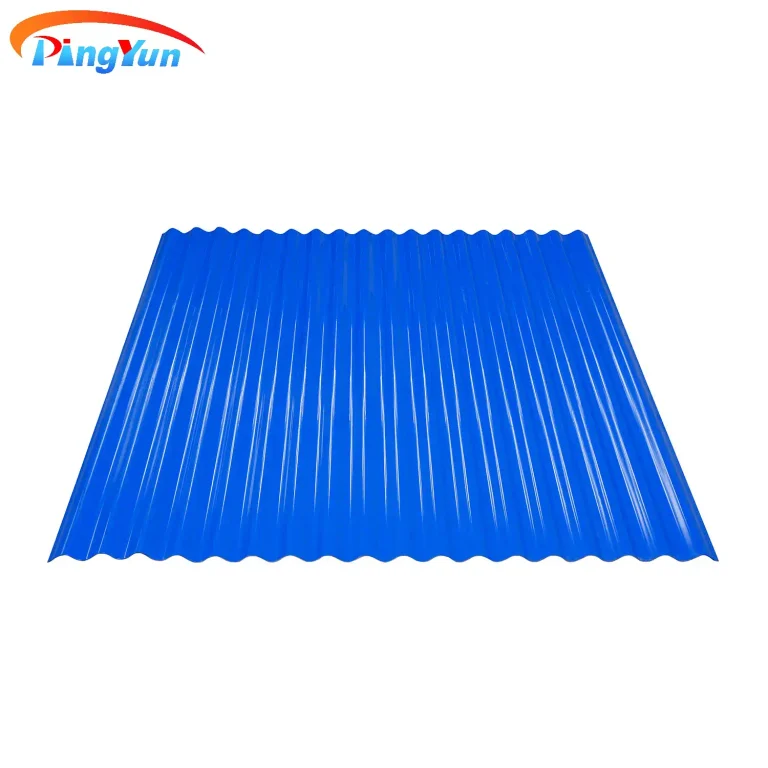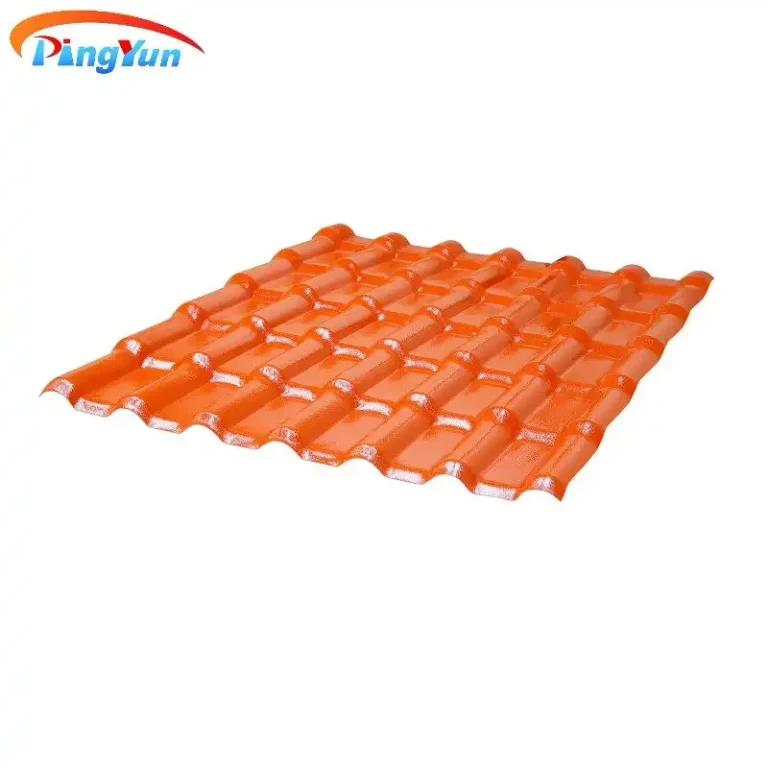
What Are PVC Roof Sheets and How Are They Used?
PVC roof sheets are profiled plastic roofing panels made from polyvinyl chloride based material and formed for use as an exposed roof covering, wall cladding element, or daylighting panel. They are not the same thing as a flexible waterproofing membrane, and they are not automatically the same as polycarbonate or fiberglass reinforced plastic. In practice, a buyer must identify the material family, profile, layer construction, width, overlap, support layout, and evidence for the intended environment before comparing prices. Pingyun’s published product map separates PVC roof tiles, corrugated UPVC sheets, twinwall hollow PVC sheets, and translucent PVC sheets; polycarbonate and FRP are listed as separate categories.[1][2] This guide explains what those categories mean, where they fit, how a roof system is assembled, and what an importer or contractor should confirm before ordering.
A useful short answer is this: a PVC roof sheet is a rigid, shaped panel that spans between roof supports and sheds rain through its profile and overlaps. Its performance depends on more than the resin name. A Spanish-style tile profile, a corrugated UPVC sheet, a hollow twinwall panel, and a translucent PVC panel may all be described as PVC roofing, yet they can differ in appearance, stiffness, light transmission, surface layer, thermal behavior, and installation details. The practical task is therefore to match a documented product configuration to the roof’s loads, climate, drainage, fire requirements, and maintenance plan rather than selecting a generic “PVC sheet.”
Table of Contents
- What Are PVC Roof Sheets Made Of?
- Which PVC Roof Sheet Types Does Pingyun List?
- Where Are PVC Roof Sheets Used?
- What Determines Performance on a Real Roof?
- How Are PVC Roof Sheets Installed as a System?
- How Should Buyers Specify and Compare Quotes?
- What Should Be Checked at Delivery and During Maintenance?
- Preguntas frecuentes
- Conclusion
- References
What Are PVC Roof Sheets Made Of?
PVC, UPVC, and ASA-PVC terminology
PVC is the base polymer family named in the product description. A roof sheet is normally not a plain, flat piece of raw resin. It is an extruded or otherwise formed panel with a roof profile, and its commercial specification may also identify stabilizers, pigments, impact modifiers, a surface layer, or multiple layers. Those formulation details matter because a sheet exposed to sunlight and weather is not judged only by whether the word PVC appears on an invoice.
UPVC is commonly used in roofing language for a rigid, unplasticized PVC formulation. The abbreviation helps distinguish a rigid building product from flexible PVC goods, but it should not be treated as a complete performance specification. Two UPVC sheets can have different thicknesses, profiles, layer structures, surface treatments, colors, and test results. Pingyun’s catalogue describes UPVC roof sheet options and shows several selectable structures, including one-layer PVC, two-layer APVC, three-layer UPVC, and four-layer ASA-UPVC examples.[1 p. 5] These are catalogue descriptions, not permission to assume that every current model is available in every structure.
ASA-PVC normally describes a PVC roofing product with an ASA weather-resistant surface layer or ASA-containing surface construction. The purpose of identifying the ASA layer is to distinguish the weather-facing surface from the core and to make the surface claim traceable to a specific product configuration. Pingyun’s historical catalogue identifies the R1050 and R1080 Spanish and Roma style examples as ASA-PVC.[1 p. 3] The current website also presents ASA PVC roof tile as a product category and lists ASA-related tile products within that category.[2][3] A buyer should still ask which exact model, layer construction, and warranty document apply to the quotation; the word “ASA” alone does not establish a universal thickness, width, service life, or test result.
The distinction is especially important when a supplier uses “PVC tile” as a broad commercial term. A colored tile-style roof may have a decorative profile and weather-facing layer, while a translucent panel may use a clear PVC formulation intended to admit light. A hollow panel may have internal cavities, while a solid corrugated sheet may not. These products should be compared by their complete bill of materials and profile, not by the shared word “plastic.”
A roof sheet is not a waterproofing membrane
A PVC roof sheet is a rigid or semi-rigid profiled panel installed over purlins, rafters, or another designed support system. It sheds water by slope, profile geometry, end laps, side laps, flashings, and drainage details. A waterproofing membrane is a different product form: ASTM D4434/D4434M-21, for example, describes flexible reinforced PVC sheets intended for exposed single-ply roofing membranes, not the profiled rigid panels discussed here.[8] A profiled roof sheet may provide weather protection, but it does not become a membrane merely because a seller calls it waterproof.
This difference affects the buyer’s questions. For a sheet, ask for profile drawings, total width, effective cover width, thickness, permitted support arrangement, fastener details, and overlap instructions. For a membrane, ask about seam welding, substrate preparation, detailing, and membrane compatibility. If an existing building requires a secondary waterproofing layer, that layer must be specified separately by the project designer. Do not assume that a PVC sheet can substitute for every underlayment, vapor control layer, insulation layer, or fire-rated roof assembly.
The same caution applies to “roofing system.” A panel is only one part of a roof. The supporting frame, purlins, ridge, verge, eave, gutters, flashings, fasteners, washers, sealants, penetrations, and any translucent or insulated zones all influence the finished result. Pingyun’s catalogue installation illustration labels a transparent roofing sheet, top ridge, UPVC roof sheet, barge board, wall cladding, and related roof-edge elements.[1 p. 6] The illustration is useful for identifying system questions, but it does not replace a current installation manual or project-specific engineering design.
Which PVC Roof Sheet Types Does Pingyun List?
Pingyun’s website organizes its roofing offer into several categories rather than treating every roof panel as one interchangeable item. The category page lists PVC Roof Tile, Corrugated UPVC Roof Sheet, Twinwall Hollow PVC Roof Sheet, and Translucent Roof Sheet. It lists Polycarbonate Sheets and FRP Transparent Roof Sheet separately.[2] This structure is a valuable starting point for procurement because it keeps material families and intended functions visible.
| Product family | What the name communicates | Questions still requiring confirmation |
|---|---|---|
| PVC roof tile | A tile-style roof profile, including Spanish and Roma style categories on the website | Exact surface construction, current model, nominal and effective widths, thickness, color, accessories, and warranty scope |
| Corrugated UPVC roof sheet | A rigid profiled sheet family with wave and trapezoidal subcategories | Profile drawing, support conditions, overlap, load tables, layer construction, and available lengths |
| Twinwall hollow PVC roof sheet | A hollow or twinwall construction intended to provide a different stiffness and thermal configuration from a solid sheet | Cavity geometry, thickness, current model, support spacing, condensation behavior, and whether it is suitable as the sole roof covering |
| Translucent PVC roof sheet | A PVC panel intended to transmit daylight in a roof zone | Current light transmission data, test method, UV and weathering evidence, fire classification, profile match, and installation limits |
| Polycarbonate or FRP | A separate material family, not a PVC substitute | Material-specific datasheet, compatibility, warranty, and project requirements |
The table is a classification aid, not a promise that every listed subcategory is stocked or that every historical model remains unchanged. A purchase order should name a current part number or an approved technical description.
Tile profiles
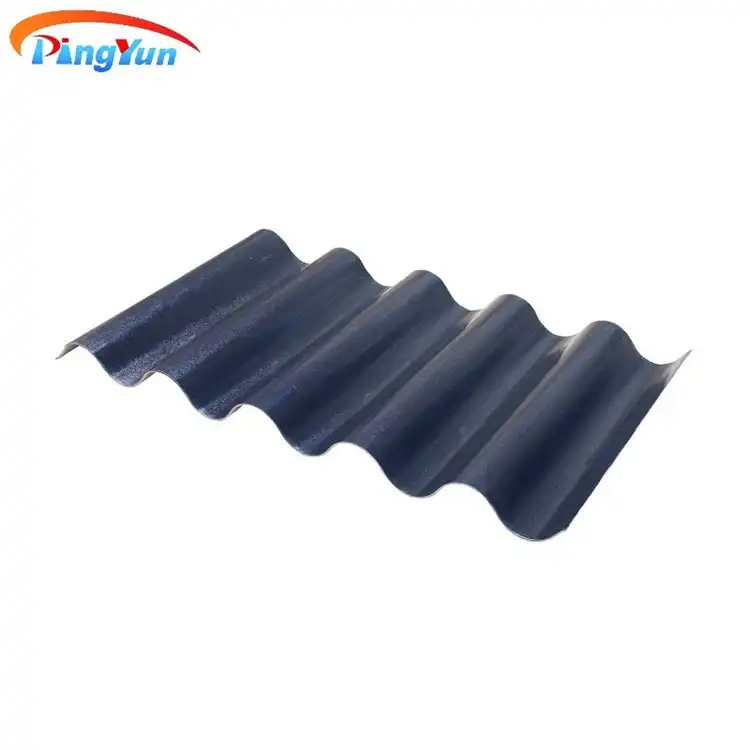
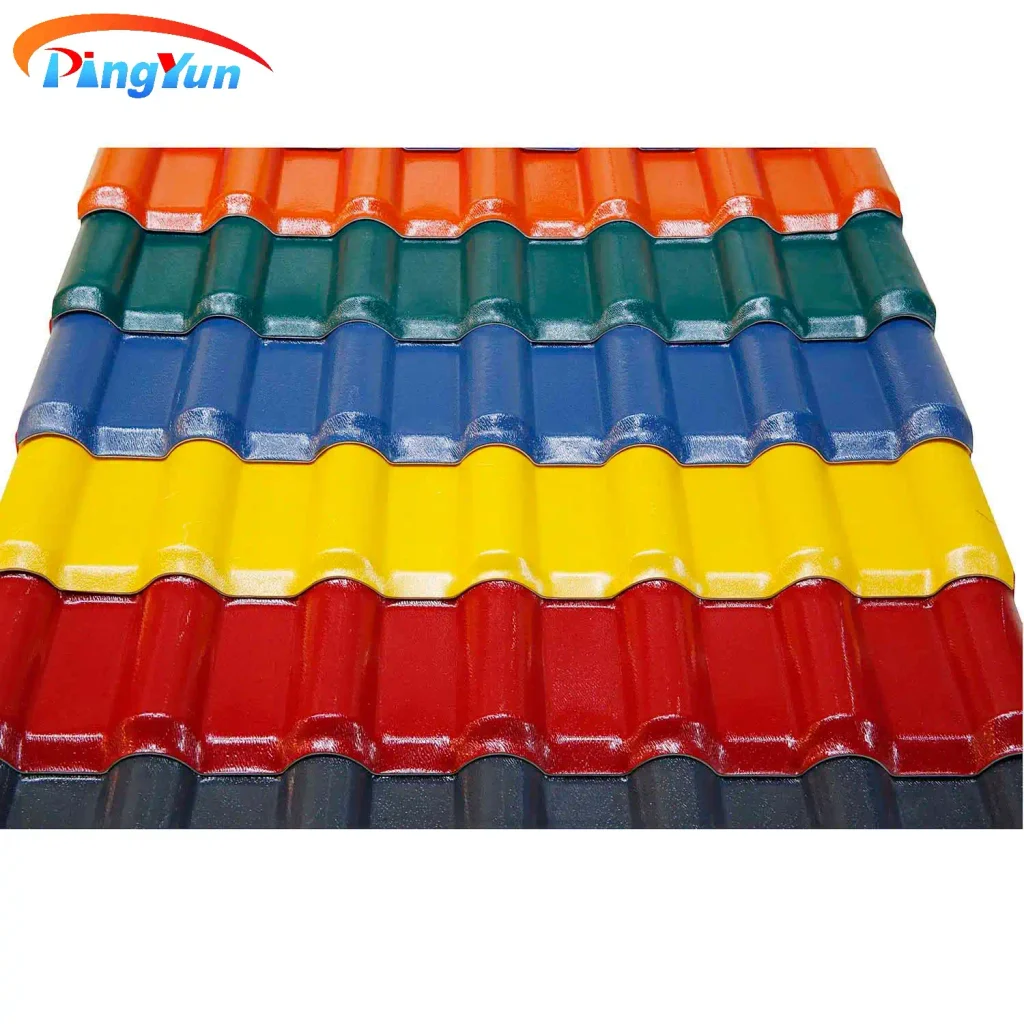
Tile-style PVC roof sheets are selected when the appearance of individual tiles is part of the design brief. Pingyun’s website places Spanish PVC Roof Tile and Roma PVC Roof Tile beneath the PVC Roof Tile category.[2][3] The historical catalogue provides examples named R1050 Spanish style and R1080 Roma style and identifies their historical material field as ASA-PVC.[1 p. 3] These examples show why a buyer should state the profile family, not just “PVC roof tile.” A tile profile determines visual rhythm, side-lap behavior, ridge and verge detailing, and the way the roof is measured for coverage.
Tile-style sheets may be suitable for houses, villas, pavilions, prefabricated buildings, and similar roof forms when the structure, slope, climate, and local requirements are compatible. The historical catalogue described those application contexts for its examples, but those descriptions should not be converted into a guarantee for every current model or site.[1 p. 3] The supplier should confirm whether the quoted item is a full ASA-PVC construction, an ASA-faced construction, a different PVC structure, or another product sold under a similar appearance.
For a tile profile, request a cross-section drawing. The drawing should show crest and valley geometry, sheet edge position, nominal width, and the region that disappears beneath the adjacent sheet. Also ask how ridge caps, barge boards, valley pieces, and wall abutments are formed. A visually attractive profile can still be difficult to install if the roof’s perimeter and penetration details have not been designed.
Wave and trapezoidal sheets
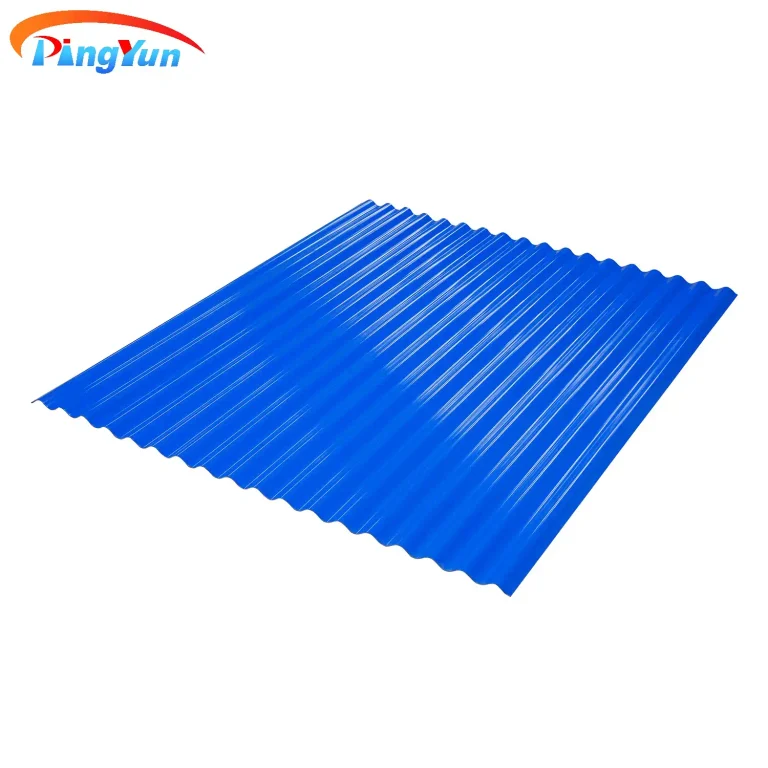
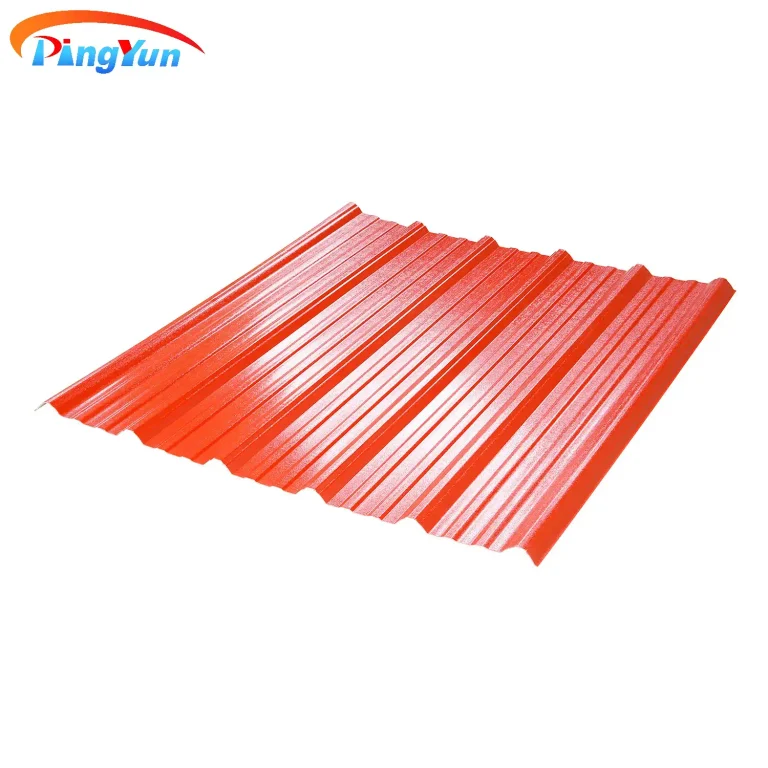
Wave sheets use repeated curved corrugations, while trapezoidal sheets use a ribbed geometry with sloping sides and flatter or more angular panels between ribs. The profile changes how the sheet carries load, overlaps, drains, and interfaces with fasteners. Pingyun lists Wave UPVC Roof Sheet and Trapezoidal UPVC Roof Sheet as separate subcategories under Corrugated UPVC Roof Sheet.[2][4]
The historical catalogue lists wave-style examples such as W720, W930, W1130, and W1350, and trapezoidal examples including R101, ST1140, HT910, HT940, HT1035, HT1075, T900, T1130, and T1350.[1 p. 7] These are historical catalogue examples only. Their names should not be read as a current product list, and the numbers should not be used to estimate a current sheet’s width, capacity, spacing, or price. They demonstrate the range of profile naming that a buyer may encounter and the need to connect each name to a current drawing.
Wave and trapezoidal sheets are often considered for warehouses, workshops, agricultural buildings, canopies, wall cladding, and utility structures because the profiles are familiar to installers and can be coordinated with metal or other profiled roof layouts. Suitability is conditional. A light sheet is not automatically a walkable roof, and a profile that works on one purlin arrangement may deflect excessively on another. Wind uplift, snow, maintenance loads, fastener pull-out, and edge conditions must be checked for the project rather than inferred from a marketing photograph.
Hollow and translucent options
A twinwall or hollow PVC panel has internal voids or separated layers that make its construction different from a solid corrugated sheet. The cavities can change weight, stiffness, heat flow, sound behavior, and the way cut edges must be protected from dirt or water. Pingyun lists T860 Hollow Roof Sheet, T930 Hollow Roof Sheet, and PVC Hollow Panel beneath Twinwall Hollow PVC Roof Sheet on its website.[2][5]
The historical catalogue calls its hollow roofing example “PVC Hollow Thermo Roof” and identifies H885 and H910 as ASA-PVC examples with different historical thicknesses and purlin-distance statements.[1 p. 7] Those figures are not current universal design values. They must not be copied into a new project without a current product datasheet, a load table, and written installation guidance for the exact model. “Hollow” also does not mean that the product can replace a complete insulated sandwich panel or a separately designed thermal layer. Ask what thermal performance is documented, under what test conditions, and whether the panel is intended as the primary weathering layer, an internal liner, or part of a composite roof.
A translucent PVC sheet is intended to admit daylight, but transparency is not the same as a certified daylight design. Pingyun’s category page separates PVC Translucent Roof Sheet from FRP Transparent Roof Sheet under Translucent Roof Sheet.[2][6] The historical catalogue describes a PVC translucent example called T900 and a separate FRP example, with different material descriptions and historical transmission statements.[1 p. 8] The FRP figures cannot be applied to PVC. Nor should an old T900 value be used as the current transmission specification without a current datasheet and test method.
Daylighting panels should be coordinated with opaque sheets of a matching profile. Their side laps, end laps, thermal movement, sealants, fasteners, and color can affect leakage and appearance. The design should also consider glare, heat gain, condensation, internal humidity, and whether a fire strategy permits the proposed translucent area. A panel that admits useful daylight in a greenhouse may not be appropriate as a large unshaded opening over a heat-sensitive work area.
How to read historical catalogue examples
The 2018 Pingyun catalogue is useful historical evidence of product families, profile names, layer terminology, and system components. It is not a current price list, stock report, universal specification, or current warranty statement. In particular, its historical marketing claims included warranty periods that do not control the current policy. The Pingyun representative’s confirmed policy for this guide is that ASA products carry a 20-year warranty while other products carry a 10-year warranty, subject to written terms for the identified product; samples are free, with freight paid by the customer.[7] These current policy points should be confirmed in the quotation or warranty document and should not be replaced by old catalogue slogans.
The safe method is to use the old catalogue for questions, not assumptions. If an old page shows a width, ask the supplier for the current total width and effective cover width. If it shows a purlin distance, ask for the current structural table and the applicable load case. If it shows an ASA label, ask which current models are actually ASA and whether the warranty applies to that exact model. If it shows a translucent or FRP option, ask for a current material-specific test report. This approach preserves useful historical information without presenting obsolete data as a current promise.
Where Are PVC Roof Sheets Used?
The right application is defined by the roof’s exposure and function, not by a generic claim that PVC is “for all buildings.” Start with the building type, climate, roof geometry, required appearance, daylight objective, expected maintenance access, and local code requirements. Then select a profile and material construction that can be documented for those conditions.
Industrial, agricultural, and utility roofs
Corrugated UPVC sheets can be considered for industrial, agricultural, workshop, storage, and utility roof zones where a lightweight profiled covering is appropriate. Pingyun’s category structure identifies wave and trapezoidal UPVC options, while the historical catalogue uses industrial and agricultural style roof imagery and discusses anti-corrosive, heat-insulation, lightweight, waterproof, and related features as product claims.[1 p. 5][2][4] Those words identify questions a buyer should investigate; the catalogue labels are supplier claims, not independent test reports or a project design.
In an industrial or agricultural environment, the roof may be exposed to humid air, fertilizers, cleaning chemicals, dust, exhaust, animal waste, salt, or frequent condensation. “Anti-corrosive” must therefore be tied to a chemical list, concentration, temperature, exposure time, and test or field evidence. A product that performs well in ordinary rain may need a different specification near aggressive vapors. Ask whether the claim concerns the sheet surface, the core resin, the fasteners, or the complete roof assembly. Metal flashings and untreated fasteners can become the weak point even when the plastic panel itself resists a particular exposure.
For workshops and warehouses, consider whether the roof needs daylight, acoustic control, insulation, smoke control, or a fire classification. A translucent strip can admit daylight, but any effect on electric-lighting use or indoor heat depends on glazing area, light control, weather and building operation. Its cleaning and weathering needs should be assessed for the selected sheet. A hollow panel may change thermal behavior but is not automatically a tested insulation system. The building services designer and structural designer should coordinate these choices.
Agricultural buildings deserve special attention to condensation and cleaning. Warm, moist interior air can condense beneath a roof even when the panel does not leak. Ventilation, roof pitch, insulation, and internal humidity control may be more important than simply choosing a thicker panel. Where wash-down is expected, confirm cleaner compatibility and drainage details before installation.
Residential and tile-style roofs
Spanish or Roma style sheets are considered when a project wants a tile-like appearance with a lighter profiled panel. Pingyun’s website lists Spanish and Roma subcategories, and its historical catalogue associates the R1050 and R1080 examples with residential houses, villas, prefabricated houses, and pavilions.[1 p. 3][2][3] These references describe the product examples in those sources; they do not prove that every residential roof in every climate is suitable.
For a home or villa, the buyer should evaluate more than color. Check roof slope, wind exposure, under-roof ventilation, rain noise expectations, attic temperature, snow or maintenance loads, fire rules, and compatibility with chimneys, skylights, solar equipment, gutters, and wall junctions. The tile appearance must continue through ridge and verge details, or the finished roof may look incomplete even if the field sheets are correct.
The supplier should state whether color is integral to the material, part of a surface layer, or achieved through another coating method. If the purchase depends on long-term color stability, ask for the current ASA identification and written warranty scope. Do not use the old catalogue’s 30-year promotional wording as the current warranty. The Pingyun representative confirmed a 20-year warranty for ASA products and a 10-year warranty for other products; record the exact model and applicable written terms.[7]
Daylighting and insulated roof zones
Daylighting is a design function, not merely a color choice. Pingyun lists translucent PVC and transparent FRP as separate products, and the historical catalogue presents PVC and FRP daylighting examples for greenhouse and warehouse contexts.[1 p. 8][2][6] A project team should decide how much daylight is wanted, how it is distributed, how glare and heat are managed, and how the translucent panels are supported and sealed.
Use the material identity stated on the quote. Do not substitute a PC sheet or an FRP sheet for a PVC translucent sheet without a deliberate design review. PC, PVC, and FRP can have different fire behavior, expansion, surface durability, chemical compatibility, and warranty conditions. The fact that a website groups products under “Translucent Roof Sheet” does not erase those material differences.
Insulated roof zones require the same discipline. Hollow PVC construction may contribute thermal resistance, but a quantified comparison with a single-layer arrangement requires data for the exact products under comparable conditions. The installed result also depends on cavities, joints, ventilation, solar exposure and the rest of the roof. If the brief requires a U-value, condensation control, or an energy target, request a calculation or test evidence for the complete assembly. Do not convert the label “ThermoRoof” into a guaranteed project performance value.
What Determines Performance on a Real Roof?
A roof’s performance is a chain of interactions. Material, profile, thickness, color, surface layer, span, support, fastening, slope, overlap, drainage, weather, and maintenance all matter. A supplier’s brochure can identify a product family, but a project specification needs a controlled configuration and evidence suited to the intended conditions.
Exposure, material, and surface layer
Start by describing exposure in practical terms: sunlight intensity, temperature range, humidity, coastal salt, industrial pollutants, fertilizers, animal housing, cleaning chemicals, wind, snow, hail, and access for maintenance. Then ask what part of the product addresses that exposure. An ASA surface layer may be intended for weathering and color stability, but the buyer still needs the current model’s construction and warranty. A pigment or clear layer may affect appearance and solar absorption. A hollow geometry may affect internal condensation and edge protection.
A useful supplier response should identify the exposed face, core material, layer count, nominal thickness, profile, and permitted fabrication. “Three layers” is not enough unless the supplier identifies which layers are present and how they are verified. For a long-term roof, request a batch or production marking where available, a datasheet, and a sample that shows the actual cross-section. If the project is sensitive to color, compare the approved sample against the final batch before mass installation.
Profile, spans, and loads
The profile is a structural shape, not decoration. It distributes load between supports, affects deflection, controls the amount of overlap, and determines where fasteners can be placed. The total width of a sheet is the physical edge-to-edge dimension. The effective cover width is the width remaining after side-lap engagement with the adjacent sheet. These two values are not interchangeable.
A quote that says “one-meter sheet” is incomplete. Ask for both total width and effective cover width, with the profile drawing showing how the measurement is taken. Also ask whether the stated width includes a designed side lap, whether a special edge profile is used at the roof boundary, and whether the same width applies across different thicknesses or materials. The historical catalogue’s R101 example included separate width and effective-cover claims, but those historical figures must not be used as current values for another model.[1 p. 5]
The length has a similar issue. A nominal cut length may not equal the visible drainage length after an end lap. If the roof needs multiple rows, the buyer must know the recommended end lap, the direction of installation, and whether a seal or support is required at the joint. Long sheets can reduce end joints, but they can also create handling, transport, thermal movement, and lifting challenges.
Structural verification belongs to the project engineer. The supplier should provide current load tables or design limits for the exact profile, thickness, support orientation, fastening pattern, and applicable wind or snow condition. A historical purlin-distance statement is not a universal design value. Never allow workers to walk on an unsupported sheet merely because it appears rigid. Provide dedicated access boards, platforms, or another safe method specified by the site safety plan.
UV, heat, fire, and chemical claims
The four claims most likely to be misunderstood are weather resistance, thermal performance, fire behavior, and corrosion resistance. Each requires a different kind of evidence.
| Claim | Evidence to request | What the evidence should identify |
|---|---|---|
| UV or weather resistance | Current warranty, weathering test, color-retention statement, or other controlled evidence | Exact model, surface layer, exposure method, duration, rating, and limitations |
| Heat insulation | Thermal test, declared thermal property, or assembly calculation | Thickness, cavity, boundary conditions, joints, and whether the result concerns the panel or complete roof |
| Fire performance | Fire classification or test report accepted for the project | Standard, specimen construction, thickness, mounting, classification, and validity |
| Chemical or corrosion resistance | Compatibility statement or chemical exposure test | Chemical, concentration, temperature, duration, cleaning method, and affected components |
| Light transmission | Current optical test or datasheet | Material, thickness, color, test method, wavelength or reporting basis, and tolerance |
Pingyun’s historical catalogue uses feature labels such as anti-corrosive, heat insulation, fire proof, color stable, UV-resistant, impact resistance, sound-proof, environmentally friendly, and waterproof for an UPVC roof sheet example.[1 p. 5] These labels are useful prompts for document requests, but they are not independent certificates. The project specification should require evidence in the format demanded by the local authority, insurer, or engineer.
Fire performance deserves particular care. A plastic roof product may be described in marketing language as fire proof, yet a building code may require a specific reaction-to-fire classification, external fire performance, fire resistance period, or tested roof assembly. Ask for the standard and report, not just an adjective. If no acceptable evidence is supplied, state that the fire requirement remains unverified and obtain a design decision before ordering.
The same logic applies to heat insulation. A hollow cross-section can create a thermal benefit, but “insulated” does not provide a numeric design result without test conditions. The roof may also need separate insulation, a vapor-control layer, ventilation, or condensation management. Treat a product feature and a building-energy calculation as different documents.
How Are PVC Roof Sheets Installed as a System?
A PVC roof sheet is installed as part of a coordinated assembly. The installer must know the roof fall, support orientation, overlap direction, edge details, fastening schedule, sealant compatibility, and safe access method before sheets are lifted onto the frame. A panel should not be treated like a loose cover that can be improvised around the ridge or wall.
Support, overlap, and fasteners
The first installation question is where the sheet is supported. Purlins or rafters must be aligned with the profile and spaced according to the current structural guidance for the exact model. The old catalogue shows support and installation concepts, but its historical distances are not a substitute for current engineering information.[1 p. 7] The installer should have a current drawing identifying support lines, sheet orientation, permitted cantilever, fastener locations, and the treatment of end joints.
Side laps are the longitudinal joints between adjacent sheets. End laps occur where one sheet terminates and another begins down the roof slope. Both have to be placed so that water flows over the upper sheet and into the lower sheet rather than into an exposed joint. The required overlap depends on profile, roof slope, local weather, sheet length, and the manufacturer’s instructions. It should not be chosen from a generic rule copied from another material.
Fasteners should be selected as a system. Their type, length, washer, sealing element, corrosion resistance, and location must suit the support material and the sheet profile. An over-tightened fastener can crush a rib, distort a washer, or restrict thermal movement. An under-tightened fastener can permit leakage and wind movement. A hole that is too close to an edge can tear, while a hole that does not accommodate the specified movement can create stress around the fixing. These are installer and engineering decisions that should follow the current product manual.
Sealants and tapes deserve the same attention. Some solvents, plasticizers, adhesives, or cleaning chemicals can be incompatible with PVC or a surface layer. Ask for a compatibility statement before applying a sealant at laps, penetrations, skylight interfaces, or ridge pieces. The supplier should identify whether a sealing product is supplied, approved, or merely suggested by a distributor. A generic silicone label is not proof of compatibility.
The installation sequence should keep the roof weather-tight as work progresses. Sheets are usually aligned from a chosen edge, with the overlap direction coordinated with prevailing weather and drainage. Edges should be checked before the next sheet is fixed, because a small alignment error can accumulate across a roof. Cut panels should be deburred and protected according to the manufacturer’s instructions, especially when cutting a hollow product.
Ridge, eave, flashing, and drainage
Joints and transitions are important leakage paths to inspect; the cause of any particular leak must be established on the installed roof rather than assumed from where water appears indoors. At the ridge, a cap or top-ridge component must match the profile and roof slope. At the verge, a barge board or edge flashing protects the side of the sheet and completes the appearance. At the eave, the sheet should discharge into a planned gutter or other drainage path without allowing wind-driven rain to enter the roof build-up. Wall abutments need flashing, closure, or another approved detail appropriate to the construction.
Pingyun’s historical installation page illustrates a top ridge, barge board, wall cladding, and transparent roofing sheet in relation to a UPVC roof sheet.[1 p. 6] This shows that the roof edge and wall interface are part of the product conversation. It does not establish that every illustrated accessory is currently stocked or compatible with every current profile. The quotation should list accessory names, dimensions, material, finish, and profile compatibility.
Drainage design should account for roof slope, sheet profile, lap direction, gutter capacity, downspout location, overflow routes, and debris. A roof that is technically waterproof at a lap can still leak if water ponds at a low point or backs up under an eave. Leaves and dust can block gutters, so inspection access and cleaning provisions should be planned. Where a translucent strip meets an opaque panel, the transition must be sealed without preventing necessary movement.
Penetrations for vents, pipes, cables, solar equipment, and maintenance fixtures require purpose-designed flashings. Cutting a hole and filling the gap with a large amount of sealant is not a durable detail. The flashing should accommodate the profile and any movement, and the support around the penetration should be designed so the panel is not carrying an unintended concentrated load.
Movement and safe access
Plastic panels expand and contract with temperature. The installation needs to permit the movement required by the current manual while retaining a weather seal. Sheet length, dark color, solar exposure, fixing pattern, and support temperature can affect movement. This is one reason a very long sheet is not automatically the best sheet: it may reduce an end joint while increasing handling and movement demands.
Workers must use a safe roof-access method. A profiled PVC sheet should not be assumed to support a person, even if it appears thick or has a strong rib. OSHA’s roofing-worker guidance emphasizes planning, appropriate equipment and training to address fall hazards; its U.S. regulatory details are not a substitute for local rules.[9] Temporary boards, crawl boards, platforms, or permanent walkways must be designed and used under the site safety plan. Work should stop during high wind, rain, frost, or other conditions that make the surface slippery or unstable. The contractor should communicate where no-step zones exist, especially over translucent, hollow, or unsupported areas.
Before handover, inspect the ridge, laps, flashings, fasteners, cut edges, gutters, downspouts, and penetrations. Remove swarf and protective film according to the supplier’s instructions. Metal filings left on a wet roof can stain surfaces or accelerate corrosion of nearby components. Do not use aggressive tools or solvents that could scratch or soften the panel.
How Should Buyers Specify and Compare Quotes?
A clear request for quotation reduces the chance that different suppliers price different products. Start with the building and work backward to the panel. State whether the requirement is for a new roof, replacement covering, wall cladding, a daylighting strip, a canopy, or a decorative tile-style roof. Include site location, approximate roof dimensions, roof slope, support material, environmental exposure, desired appearance, expected loads, code obligations, and target delivery date.
RFQ data fields
The following fields are useful in an RFQ. They are prompts, not a substitute for the supplier’s approved technical documents.
| RFQ field | Why it matters |
|---|---|
| Product family and exact model | Prevents a broad “PVC sheet” description from hiding different constructions |
| Material and surface layer | Separates PVC, UPVC, ASA-PVC, translucent PVC, PC, and FRP without mixing them |
| Profile drawing or profile name | Controls side laps, end laps, ridge pieces, fastener location, and appearance |
| Total width and effective cover width | Allows a real area takeoff and avoids confusing edge-to-edge width with installed coverage |
| Thickness and layer structure | Affects stiffness, weight, thermal behavior, and price; must be tied to a current model |
| Sheet length and cutting tolerance | Affects transport, lifting, end joints, waste, and movement |
| Color and finish | Controls appearance and may affect solar absorption and batch approval |
| Support and load information | Allows the engineer to check span, wind, snow, maintenance, and uplift conditions |
| Accessories | Identifies ridge, verge, eave, closures, flashing, fasteners, washers, and sealants |
| Evidence package | Identifies current datasheet, test reports, certificates, installation manual, and warranty |
| Packing and shipment | Protects long or thin panels from bending, impact, moisture, and edge damage |
| Quantity and delivery basis | Clarifies whether the quote uses net roof area, cover area, sheet count, or packaged quantity |
| Warranty and sample terms | Records the current warranty category and the cost responsibility for freight |
Request a line-by-line quotation. The seller should show material, profile, thickness, width, length, quantity, unit, accessories, packing, delivery term, lead time, payment terms, and document list. If a dimension is not yet fixed, the quote should identify it as a confirmation item rather than silently assuming a standard size.
Total width versus effective cover width
This distinction is central to purchasing. Total width is the physical width of the manufactured panel. Effective cover width is the installed width after the side lap is engaged. The effective value is the number needed for the roof area calculation, while the total value is needed to plan handling, packing, support edge position, and transport.
Ask the supplier to show both dimensions on the same profile drawing. Ask whether effective cover width changes with the selected lap, whether a special overlap is required at a roof edge, and whether the figure includes a tolerance. For tile profiles, visual module width and effective cover width may also be described differently. Do not multiply a nominal width by a sheet count and assume the roof will cover the result.
The historical R1050 and R1080 examples illustrate that profile names can be associated with different widths, while the historical UPVC R101 example separately discussed nominal width and effective coverage.[1 p. 3][1 p. 5] Those old values are not current specifications for unspecified products. Their procurement lesson remains valid: record the measurement definitions and the exact model.
Samples and batch matching
Pingyun’s representative confirmed that samples are free while the customer pays freight.[7] The request should still identify the model, color, thickness, profile, surface layer, and requested dimensions so the sample is meaningful. A small flat cut may show color but not reveal the complete profile or layer structure. Where the construction matters, ask for a representative cross-section or a sample that includes the rib and surface.
Keep the approved sample with the purchasing record. Record photographs under consistent lighting, sample identification, date, and any visible markings. When the production batch arrives, compare color, gloss, profile, thickness, surface, edge condition, and layer appearance against the approved sample. A sample is not a guarantee that an unrecorded model will match; it is useful only when the sample and order description are tied together.
For a multi-building project, agree how color variation will be handled. Store panels so they are protected from direct sun, water accumulation, impact, and excessive heat before installation. If the supplier provides a batch number, retain it with the delivery documents. If an apparent color or profile discrepancy appears, quarantine representative pieces and notify the supplier before installation spreads the issue across the roof.
Shipment, accessories, and warranty
Long panels need packaging that prevents bending, edge impact, abrasion, and movement during transport. Ask about bundle dimensions, maximum panel length, loading method, unloading equipment, and storage requirements. A delivery that reaches the site undamaged but cannot be safely unloaded is not a successful logistics plan. The buyer should also check whether the quoted freight basis includes accessories or only field sheets.
The Pingyun representative confirmed the policy distinction: ASA products have a 20-year warranty; other products have a 10-year warranty.[7] Record it against the exact quoted product. Do not apply the ASA term to a generic UPVC, hollow PVC, or translucent PVC quotation. Do not interpret a historical catalogue’s 30-year or 20-year promotional wording as the current policy.[1 p. 3][1 p. 5] Ask for the warranty document and confirm the covered product, start date, claim process, required installation conditions, color or weathering scope, exclusions, remedy, and whether the warranty is transferable. If those terms are not supplied, report the duration as a policy statement requiring written product-specific confirmation rather than presenting it as a complete legal warranty.
The website shows many product categories and product pages, but a category listing does not prove current inventory, a fixed specification, or a universal certification.[2][3][4][5][6] Request current documents for the actual quotation. A professional procurement file should preserve the web page capture or date, the supplier response, the approved drawing, the sample record, and the final purchase order.
What Should Be Checked at Delivery and During Maintenance?
Delivery inspection should be systematic and should happen before panels are distributed around the site. Check the packing list against the purchase order, then inspect the bundles and accessible panels for crushed edges, scratches, punctures, cracks, distortion, contamination, incorrect color, incorrect profile, and moisture damage. Photograph the packaging labels and any damage before unloading is complete.
Identity and damage
Verify that the delivered material is the specified family: PVC roof tile, corrugated UPVC, hollow PVC, or translucent PVC. If the order specifies ASA, verify the model and documentation rather than relying only on a color or sales description. Check length, total width, effective cover width, thickness, profile, and quantity against the approved documents. Random measurement can identify an obvious mismatch, but acceptance criteria should be agreed before delivery.
Do not install damaged panels to “use them up.” A crack at a fastener, crushed rib, delaminated surface, blocked hollow edge, or deep scratch can become a leakage or weathering problem. Segregate questionable pieces and ask the supplier for a disposition. Any field repair must be approved for the specific material and location; an improvised patch can create a compatibility or movement issue.
Storage matters. Stack panels on a flat, supported surface, keep bundles stable, protect them from impact and direct heat, and prevent water from being trapped between sheets. Follow the current supplier storage instructions, especially for hollow panels and panels with a weather-resistant surface. Do not drag sheets across one another or place heavy objects on the bundle.
Inspections and repair decisions
Routine inspection should cover ridge and verge details, laps, fasteners, flashings, gutters, downspouts, penetrations, surface condition, and signs of movement. Look for lifted edges, loose washers, staining beneath laps, blocked drainage, unusual cracking, chalking, discoloration, and impact damage. Inspection frequency should reflect exposure, storm history, tree cover, industrial pollution, and access conditions.
Clean with methods approved for the product. Use soft tools and compatible water or detergent where permitted; avoid abrasive pads, harsh solvents, uncontrolled pressure washing, and scraping that can damage the surface layer. Remove leaves and debris from gutters and roof valleys without walking directly on the panels. A building owner should keep a record of cleaning, inspection, repairs, severe weather, and any replacement pieces.
If a leak appears, find the path rather than sealing the first visible mark. Water can travel along a profile, fastener line, purlin, or flashing before appearing inside. Check the ridge, side lap, end lap, penetration, eave, and gutter in a controlled sequence. Replacement should be considered when a panel is cracked, structurally distorted, badly weathered, or no longer compatible with the surrounding system. Before mixing a replacement panel with an older roof, confirm profile, color, surface construction, and movement behavior.
Preguntas frecuentes
Are PVC and UPVC roof sheets the same?
They are related but not automatically identical. PVC names the polymer family, while UPVC is commonly used for a rigid, unplasticized PVC roofing formulation. The complete specification still depends on profile, thickness, layer construction, surface, color, and test evidence. Pingyun lists PVC roof tiles, corrugated UPVC sheets, hollow PVC sheets, and translucent PVC as distinct product categories or subcategories.[2]
Does every PVC roof tile have an ASA surface?
No assumption should be made. Pingyun’s historical examples R1050 and R1080 are identified as ASA-PVC, and the current website has an ASA PVC Roof Tile category.[1 p. 3][2][3] A quotation must identify whether the exact model is ASA, how the surface is constructed, and which warranty applies. “PVC roof tile” by itself is not enough to establish ASA content.
Are the old R1050, R1080, R101, T1130, H885, H910, and T900 numbers current standard specifications?
No. They are historical product examples from the 2018 catalogue. They are useful for understanding profile names, material labels, and the kinds of dimensions a buyer should request, but their numbers must not be extended to the current range or treated as universal current specifications.[1 p. 3][1 p. 5][1 p. 7][1 p. 8] Ask for a current datasheet and drawing for the quoted item.
What is the difference between total width and effective cover width?
Total width is measured from one physical sheet edge to the other. Effective cover width is the installed width remaining after the side lap is engaged. The latter is used to estimate installed coverage. Ask for both values and the measurement definition on the profile drawing, because a nominal width can overstate the area covered by each sheet.
Does a hollow PVC roof sheet replace insulation?
Not automatically. A hollow construction may change heat transfer and stiffness, but it does not prove a required thermal performance for a complete building. Request current thermal evidence for the exact panel and assembly, and coordinate it with condensation control, ventilation, vapor control, and any separate insulation required by the project.
Can PVC, polycarbonate, and FRP translucent sheets be mixed freely?
No. Pingyun lists polycarbonate and FRP separately from PVC categories, and the historical catalogue separately describes translucent PVC and transparent FRP.[1 p. 8][2] Different materials can have different movement, fire behavior, chemical compatibility, surface durability, and warranty conditions. Mixing materials requires a deliberate detail review and written compatibility confirmation.
Is a translucent PVC panel the same as a transparent panel?
The words describe appearance or light function, not a complete performance grade. A translucent PVC panel may admit daylight without being optically clear, and its transmission depends on material, thickness, color, surface, and test method. Request current transmission data for the exact model. Do not transfer FRP or PC transmission figures to PVC.
Can I use historical purlin spacing from a catalogue?
Not without current confirmation and engineering review. Support distance depends on profile, thickness, load, wind, snow, fasteners, roof geometry, and local conditions. Historical catalogue statements are context, not universal design values. Obtain the current load table or written design guidance for the exact product and site.
Does a fire-proof label prove code compliance?
No. A project may require a particular reaction-to-fire, external fire, or fire-resistance classification. Request the applicable test report or certificate, including standard, specimen construction, thickness, mounting, and validity. If the evidence is absent or does not match the proposed assembly, the requirement remains unverified.
What evidence supports an anti-corrosion claim?
Ask what exposure the claim covers, including chemical, concentration, temperature, duration, and cleaning method. Confirm whether the evidence concerns the PVC panel alone or the complete roof, including fasteners, flashings, sealants, and supports. A general marketing phrase cannot predict performance in every industrial or agricultural atmosphere.
Are samples free?
Pingyun’s representative confirmed that samples are free and the customer pays freight.[7] Ask for the exact model, color, thickness, profile, and sample dimensions to be recorded in the quotation or sample request. Freight responsibility should be confirmed before dispatch.
What is the current warranty period?
The Pingyun representative confirmed the current policy: 20 years for ASA products and 10 years for other products.[7] The exact model and written warranty terms still need to be confirmed. Historical catalogue claims of 30 years or 20 years must not be presented as the current policy.[1 p. 3][1 p. 5]
What should a buyer ask first when requesting a quotation?
Ask for the exact material family, model, profile drawing, total width, effective cover width, thickness, layer construction, available length, color, support and load information, accessories, current tests, installation instructions, sample terms, warranty terms, packing, and delivery basis. Those fields turn a general price request into a comparable technical RFQ.
Conclusion
PVC roof sheets are profiled building panels, not a single uniform product. The useful distinction is between material identity, profile and construction, roof function, installation system, and evidence. Pingyun’s website separates roof tiles, corrugated UPVC, hollow PVC, translucent roofing, polycarbonate, and FRP categories, while the historical catalogue shows why model names and material labels need careful interpretation.[1][2]
For a sound purchase, identify the exact product, confirm total and effective widths, obtain current support and installation information, separate PVC from PC and FRP, and require evidence for any UV, insulation, fire, light-transmission, or chemical-resistance claim that matters to the project. Use historical catalogue examples to form questions, never to invent current specifications. Request a free sample with customer-paid freight, compare delivery with the documented sample before installation, and record the product-specific warranty. Pingyun’s representative confirmed 20 years for ASA products and 10 years for other products; obtain written terms for the quoted model.[7]
The result should be a roof that is selected for its actual climate, load, drainage, daylight, fire, and maintenance requirements rather than for an isolated marketing adjective. A disciplined RFQ and a complete evidence package are usually more valuable than a superficially lower price for an unspecified sheet.
References
[1] PINGYUN, PINGYUN New catalogue 201804.pdf, knowledge-base source document, pp. 3, 5, 6, 7, and 8. Page 3 covers historical ASA-PVC tile examples R1050 and R1080 and a separate translucent PVC example. Page 5 covers historical UPVC examples R101 and T1130, layer terminology, and feature labels. Page 6 shows installation components and roof interfaces. Page 7 lists historical wave, trapezoidal, and hollow-roof examples. Page 8 separates translucent PVC from transparent FRP.
[2] PINGYUN INTERNATIONAL, “Products,” product-category page, https://www.pingyungroup.com/products.html. Accessed for the listed PVC Roof Tile, Corrugated UPVC Roof Sheet, Twinwall Hollow PVC Roof Sheet, Polycarbonate, PVC Gutter, Translucent Roof Sheet, and separate FRP and PC categories.
[3] PINGYUN INTERNATIONAL, “PVC Roof Tile,” product-category page, https://www.pingyungroup.com/PVC-Roof-Tile-pl3880300.html. Accessed for the Spanish, Roma, and ASA-related PVC roof tile category and current product-page grouping.
[4] PINGYUN INTERNATIONAL, “Corrugated UPVC Roof Sheet,” product-category page, https://www.pingyungroup.com/Corrugated-UPVC-Roof-sheet-pl3015729.html. Accessed for the wave and trapezoidal UPVC roof sheet categories.
[5] PINGYUN INTERNATIONAL, “Twinwall Hollow PVC Roof Sheet,” product-category page, https://www.pingyungroup.com/Twinwall-Hollow-PVC-Roof-Sheet-pl3579300.html. Accessed for the hollow PVC roof sheet category and listed subcategories.
[6] PINGYUN INTERNATIONAL, “Translucent Roof Sheet,” product-category page, https://www.pingyungroup.com/Translucent-Roof-Sheet-pl3479300.html. Accessed for the separate PVC translucent and FRP transparent roof sheet categories.
[7] Direct company-policy confirmation from the Pingyun representative in this conversation: ASA products carry a 20-year warranty; other products carry a 10-year warranty; samples are free and freight is paid by the customer. This confirms durations and sample-cost responsibility, not unprovided coverage or a particular model’s eligibility; obtain product-specific written terms.
[8] ASTM International, ASTM D4434/D4434M-21, “Standard Specification for Poly(Vinyl Chloride) Sheet Roofing,” Scope 1.1–1.2. This concerns flexible, fiber- or fabric-reinforced single-ply PVC roofing membrane sheets, not a test or certification of Pingyun’s rigid profiled panels. https://store.astm.org/d4434_d4434m-21.html
[9] U.S. Occupational Safety and Health Administration, Protecting Roofing Workers (OSHA 3755-05 2015), “Plan, Provide, Train” and roof-work fall-hazard guidance. This is U.S. general safety guidance, not a project approval, product load rating, or universal local regulation. https://www.osha.gov/sites/default/files/publications/OSHA3755.pdf